





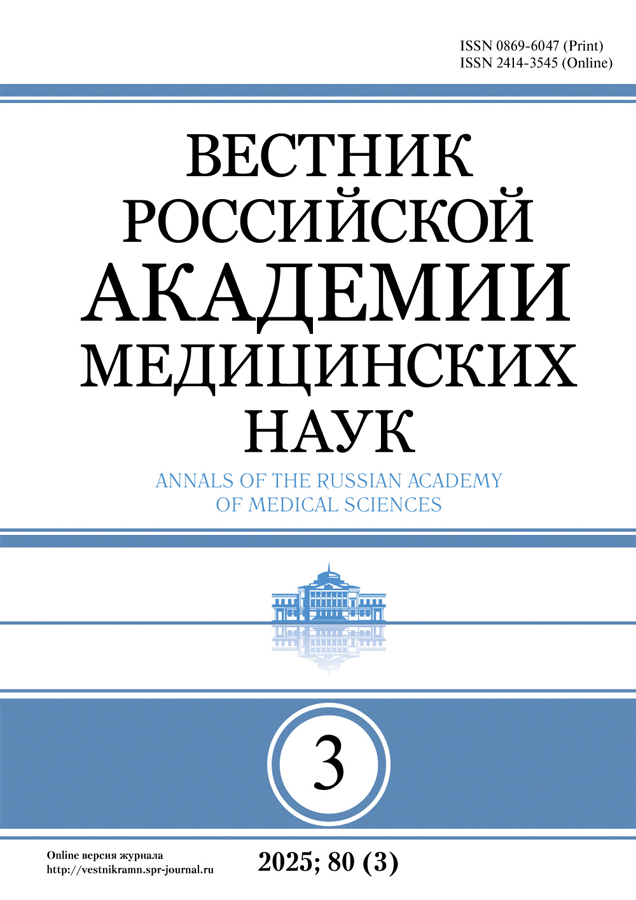
Annals of the Russian academy of medical sciences

Bimonthly peer-review medical (miscellaneous) journal
The journal "Vestnik Rossiiskoi akademii medetsinskikh nauk" = "Annals of the Russian Academy of Medical Sciences" is the authoritative scientific issue, it is published since 1946.
Editor-in-Chief
Vladimir I. Starodubov
MD, Doctor of Science (Medicine), Professor
ORCID iD: 0000-0002-3625-4278
Publisher
"Paediatrician" Publishers LLC
WEB: https://www.spr-journal.ru/
About
The journal releases regular articles, completed original clinical and experimental studies results in all spheres of medicine, and review articles on the most crucial problems of medical science and healthcare.
The main aims of the journal are the following:
- to team up scientists and practitioners;
- to draw attention to the most relevant, promising and interesting topics of medicine;
- to build up and to develop the most promising directions in scientific field;
- to provide relevant information on scientific research and new achievements;
- to maintain the experience and ideas exchange between scientists from various regions.
The journal is included in the List of leading scientific journals and publications of the Higher Attestation Commission, where the main results of scientific papers for Candidate and Doctor of medicine should be published.
The journal is indexed in Ulrich's International Periodicals Directory, Scopus, Embase, EBSCO, MedArt, Russian Science Citation Index (Web of Science).
SJR (SCImago Journal Rank) (2020): 0.122
CiteScore (CiteScore metrics) (2020): 1.0
SNIP (Source Normalized Impact per Paper) (2020): 0.271
Announcements More Announcements...
Crossref’s ORCID autoupdatePosted: 26.01.2017
Submitting the article to a journal of a Crossref member publisher, please, provide your ORCID ID. Crossref suggests automatically "pushing" the article metadata to your authors’ ORCID records when you include ORCID IDs in your metadata deposits.
|
|
|
Inclusion to the list of journals that follow ICMJE RecommendationsPosted: 24.06.2016
The academic journal contacted the ICMJE and was included in the list of journals that follow the ICMJE's Recommendations for the Conduct, Reporting, Editing and Publication of Scholarly Work in Medical Journals.
|
|
|
Current Issue
 Open Access
 Access granted
 Subscription or Fee Access
Vol 80, No 3 (2025)
- Year: 2025
- Published: 10.10.2025
- Articles: 9
- URL: https://vestnikramn.spr-journal.ru/jour/issue/view/104
- DOI: https://doi.org/10.15690/vramn.803

OBSTETRICS AND GYNAECOLOGY: CURRENT ISSUES
Induction of labor as a criterion for the staging of medical care for pregnant women
Abstract
Background: iduction of labor (IL) is a technology of early delivery for diseases and complications in pregnant women. At the same time, the frequency of IR in obstetric hospitals at various levels has not been sufficiently studied.
Аims: analyze the frequency of IL using the example of the Sverdlovsk region (SR) and of Yekaterinburg in 2014–2022.
Materials and methods: a cross-sectional simultaneous study of the frequency of IL in medical organizations of the Sverdlovsk region and the Yekaterinburg in 2014-2022 was conducted. The Federal Statistical Observation Form No. 32 «Information on medical care for pregnant women, women in labor and women in labor» was analyzed. The frequency of IL was calculated as the ratio of the number of IL to the total number of births and expressed in ppm (‰). The effectiveness of IL was determined using the coefficient of IL.
Results: the number of births in the SR decreased 1.6 times, in Yekaterinburg — 1.4 times in 2014-2022. The frequency of IL in the region was 102.3%, in the city — 177.0% in 2022. The average growth rate of the IL index was 4.3% and 4.9%, respectively, in 2015–2022. IL has not been used in obstetric hospitals of the 1st group since 2018. In obstetric hospitals of groups 2 and 3, the frequency of IL has increased in the Sverdlovsk region since 2016 (p<0.001), in the city — in 2017 (p<0.001) compared with 2014. The average growth rate of IR in obstetric hospitals of the 3 group in the Sverdlovsk region was 21%, in Yekaterinburg — 37% and was characterized by a pronounced growth trend in 2015–2022.
Conclusions: induction of labor was used only in obstetric hospitals of the 2 and 3 groups. An indicator of the frequency of induced labor is recommended for monitoring the stage of medical care for pregnant women.
 173-179


CARDIOLOGY AND CARDIOVASCULAR SURGERY: CURRENT ISSUES
The effect of A1166C polymorphism of the type 1 angiotensin II receptor gene (AGTR1) on the dynamics of blood pressure during therapy with angiotensin II receptor blockers: a randomized prospective clinical trial
Abstract
Background. More and more data confirm the need for personalized pharmacotherapeutic treatment based on the genetic characteristics of the patient, which will become the main method of future antihypertensive treatment, especially in patients with refractory hypertension, in order to rationally prescribe pharmacotherapy.
Aims — to study the pharmacodynamic parameters of the effectiveness of therapy with angiotensin II receptor blockers in the form of monotherapy and as part of combined drugs in patients with hypertension, depending on the genetic characteristics of patients – the genetic polymorphism A1166C of the angiotensin II type 1 receptor gene (AGTR1). Methods. The study included 179 patients from the Moscow region with newly diagnosed arterial hypertension (AH) of 1–2 degrees, among whom 141 (78.8%) women and 38 (21.2%) men aged 32 to 69 years, who were randomly assigned to irbesartan and valsartan groups in the form of mono- or combination therapy with hydrochlorothiazide by a simple randomization method. After 3 weeks of pharmacotherapy, the presence of the rs5186 (A1166C) genetic polymorphism of the type 1 angiotensin II receptor gene (AGTR1) was determined.
Results. After 3 months of valsartan therapy, among heterozygotes, the change in office DBP was statistically significantly less pronounced compared to the A/A genotype by an average of 5.4 mmHg (p = 0.009), and there was also a less pronounced decrease by an average of 5.6 mmHg, however, not statistically significant, in heterozygotes compared to the C/C genotype (p = 0.192). There was a tendency in patients with genotype A/C compared with genotype A/A after 3 weeks of using irbesartan in the form of a less pronounced decrease in office SAD by an average of 4.3 mmHg. The decrease in office DBP was less pronounced by an average of 5.2 mmHg (p = 0.019); patients with CC genotype also showed a less pronounced decrease in DBP (by an average of 4.2 mmHg), compared with the A/A genotype, however, this difference was not statistically significant (p = 0.48).
Conclusions. The A1166C polymorphism of the AGTR1 gene significantly affects the antihypertensive effect of valsartan in patients with grade 1–2 hypertension, leading to a decrease in DBP and an increase in HR in A/C heterozygotes compared to A/A homozygotes. No association between the polymorphism and the antihypertensive effect of irbesartan was identified; however, patients with A/C and C/C genotypes showed a less pronounced reduction in SBP and DBP. No relationship was found between genotype and the achievement of target BP levels or the need for therapy intensification. Further prospective studies with a larger sample size are required to clarify the genetic factors influencing the antihypertensive efficacy of ARBs.
180-189
Hypertension and sex hormone levels in young and middle-aged men
Abstract
Background. Hypertension is a major cardiovascular condition and exhibits significant sexual dimorphism. The prevalence of hypertension in the general population could be associated with the state of sex hormone system to a large degree. Currently the data obtained on the relationship between sex hormones and blood pressure levels are insufficient.
Aims — to study the relationship between hypertension and sex hormone levels in young and middle-aged men in a retrospective cohort study setting.
Methods. A retrospective observational clinical trial was conducted. 698 medical records of male patients aged 18 to 59 years were analyzed. 508 patients with an average age of 41.1 ± 9.4 years, obesity prevalence of 48.2%, and hypertension prevalence of 52% were selected. Blood pressure levels, anthropometric data, levels of sex hormones, lipid panel and insulin resistance indicators were analyzed.
Results. In our study group, obesity and its abdominal form were more common among patients with hypertension. A decrease in the testosterone level (< 12.1 nmol/l) was significantly more common among patients with hypertension (64.91 versus 41.98%; p ≤ 0.001). Differences in the prevalence of hyperestrogenism (estradiol level above 41.2 pg/ml) did not reach statistically significant values (29.43 versus 22.22%; p = 0.064). When dividing the study sample by estradiol tertiles, the groups significantly differed from each other in the prevalence of hypertension (p = 0.028). According to the results of multivariate logistic analysis, sex hormones made a significant contribution to the model of the presence of hypertension. High levels of estradiol were associated with a higher probability of hypertension, while lower levels reduced the probability of hypertension. The relationship between testosterone and hypertension was inverse: the higher the level of this hormone, the lower the probability of hypertension in young and middle-aged men.
Conclusions. Our study shows the presence of an independent relationship between the level of testosterone and estradiol and the presence of hypertension in young and middle-aged men.
190-197
HEALTH CARE MANAGEMENT: CURRENT ISSUES
Risks and limitations of using artificial intelligence in medicine
Abstract
The scientific, technical, ethical, and legal aspects of applying artificial intelligence (AI) in modern medicine, as well as its impact on medical professionals and patients, are examined. The research methodology is based on the analysis of scientific publications dedicated to the use of AI in medicine. Systematization of the available data allows identifying key limitations faced by developers of medical AI systems and their users. These issues are related to the quality and completeness of the data on which machine learning models are built, the limited clinical context, challenges in knowledge generalization, and system interoperability. Ethical challenges include concerns about privacy, algorithmic bias, and the distribution of responsibility. Additionally, there are issues regarding the regulatory framework for AI in healthcare and the training of medical professionals in computer technologies. Overcoming these limitations requires improving data quality, developing multimodal systems, increasing algorithm transparency, and refining the regulatory framework.
198-206
OTORHINOLARYNGOLOGY: CURRENT ISSUES
Innovative treatment and diagnostic algorithm for otosclerosis
Abstract
Background. To date, the lack of modern algorithms for the diagnosis and treatment of various forms of otosclerosis (OS) leads to progressive bilateral hearing loss, failures and complication during the operation and disability of the socially active part of the population. The development of a modern therapeutic and diagnostic algorithm for various forms of OS is an urgent topic, the development of which became possible due to the advent of modern medical technologies: high-resolution computed tomographs, microscopes, endoscopes, surgical lasers and motor systems.
Aims — to develop an innovative treatment and diagnostic algorithm for various forms of otosclerosis.
Methods. In a non-randomized controlled prospective study, the results of the examination, treatment and follow-up of 2,421 patients with OS in the period from 2009 to 2022 were analyzed. Conservative inactivating therapy was performed in 288 patients with active and 28 with cochlear forms of OS. Stapedoplasty was performed in 2,393 patients. A partial stapedectomy was performed in group 1, a piston stapedoplasty technique was performed in group 2, and a wide stapedotomy was performed in group 2. In all cases, the operation was performed with CO2 laser assistance (Acuspot 30C, Lumenis, USA). In the obliterating form of OS, various stapedoplasty techniques were performed, depending on the stage, with various means of assistance (the Skeeter Otologic Drill System motor System (Medtronic Xomed, USA) and a CO2 laser. When the active form was detected, piston stapedoplasty with CO2 laser assay was performed. The evaluation of the functional results of the developed methods of stapeplasty (stapedoplasty) was carried out according to the tonal data. Results. For the first time, based on the results of examination, treatment and treatment of a significant number of patients (2421), a modern therapeutic and diagnostic algorithm and a new clinical and radiological classification for OS have been developed. In a comparative assessment of the functional effectiveness of the developed stapedoplasty techniques, the best results were obtained after performing partial stapedectomy and wide stapedotomy (groups 1 and 3) — “excellent” results were achieved after 3 months in 96% of patients, and with piston (group 2) — after 6 months in 78% with a closure of less than 10 dB (p ≤ 0.05). Cochlear complications in the early postoperative period were detected in 0.8% of patients and recurrence of hearing loss in the long-term period in 1%.
Conclusions. The accumulated many years of experience in examining and surgical treatment of patients with OS allowed us to develop an algorithm for diagnosis, treatment and a new clinical and radiological classification, which led to an increase in the frequency of diagnosis of OS and the effectiveness of treatment of hearing loss in patients with various forms of OS.
207-218
SURGERY: CURRENT ISSUES
Comparative analysis of the results of minimally invasive and traditional surgical treatment of patients with lumbosacral spondylolisthesis
Abstract
Background. Minimally invasive surgery (MIS) has been increasingly utilized as an alternative to open surgery (OPEN) for lumbo-sacral spondylolisthesis treatment. However, comparative analyses of outcomes remain limited.
Aims — to compare perioperative and functional outcomes between MIS and OPEN in patients with lumbar spondylolisthesis.
Methods. A retrospective cohort study of 224 patients (2018–2024) was conducted. Patients were divided into MIS (n = 120) and OPEN (n = 104) groups. Outcomes analyzed included surgical duration, blood loss, hospital stay, functional recovery (Oswestry Disability Index, ODI), pain reduction (Visual Analog Scale, VAS), and complications. Statistical analysis was performed using the Wilcoxon rank-sum test (p < 0.05 considered significant).
Results. MIS demonstrated shorter operative time (145 min vs. 200 min, p < 0.001), reduced blood loss (140 mL vs. 400 mL, p < 0.001), and shorter hospital stay (4 vs. 9 days, p < 0.001). Functional recovery and pain relief were also superior in MIS, with fewer complications.
Conclusions. MIS is associated with faster recovery, lower complication rates, and improved functional outcomes compared to OPEN. These findings support the increased adoption of MIS in lumbar spondylolisthesis treatment.
219-226
PERSONALITIES
To the 70th anniversary of Academician of the Russian Academy of Sciences Vladimir Alekseevich Solodkiy
Abstract
April 27, 1955 marked the 70th anniversary of the prominent scientist, specialist in the field of oncology, radiology and healthcare organization, to the laureate of the Government of the Russian Federation Award in science and technology, Honored Doctor of the Russian Federation, Academician of the Russian Academy of Sciences Vladimir Alekseevich Solodkiy.
227-229
To the 75th Anniversary of Academician of the Russian Academy of Sciences
Abstract
May 17, 2025 marked the 75th anniversary of the birth of Vladimir Ivanovich Starodubov, a leading scientist and an outstanding specialist in the field of healthcare organization, a well-known public figure, a talented leader and teacher, a surgeon, an Honored Doctor of the Russian Federation, Doctor of Medical Sciences, Professor, Academician of the Russian Academy of Sciences.
230-232
To the 75th Anniversary of Academician of the Russian Academy of Sciences Sergey Ivanovich Kolesnikov
Abstract
On June 1, 2025, the 75th anniversary was celebrated by the largest Russian scientist, embryologist, outstanding specialist in the field of development biology, ethnic features of health and diseases, well-known organizer in the field of science and education, political and public figure, winner of the Lenin Komsomol Prize in Science and Technology, winner of the Prize of the Government of the Russian Federation in Science and Technology, Honored Scientist of the Russian Federation, Academician of the Russian Academy of Sciences Sergey Ivanovich Kolesnikov.
233-235